January 22, 2008

Refinement

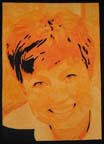
Trying to refine a picture is one of the most challenging things to do. I move away from the pattern and use the original photograph to make alterations. The goal is to give the essence of the person in the quilt.

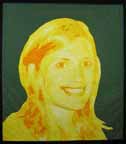
I have made subtle changes to the yellow portrait. This is what I started with:

Amy in process again

This morning, I added deeper color to her eyebrows and the area around her eyes. I also made the eye on the right side smaller since that side of the face is receding away from the viewer.

070122 001

I then decided that there was not enough highlight on the right eye in the corner by the nose so I added a lighter color there. I needed deeper shadows in a few places to highlight certain areas so I added deeper color under the chin, in the throat area, and on the right side of the face to give more separation between the face and her hair.

070122 003

At this point, the mouth still looked wrong to me. At some point, I had cut away the shadow of the upper lip on the right hand side because it was too deep — but in hindsight, there needed to be some deeper line there to show the full character of the smile. I raised the lip a quarter inch or so and changed the shadow so that it created a crease in its corner.

070122 004

I feel very good about the piece at this point.

January 17, 2008

Working Through Fear and Difficulty

OK. I received a bunch of really helpful feedback from some of the members of quiltart. It is so helpful to belong to this group (www.quiltart.com). Constructive criticism can be hard to come by since I don’t have a creative outlet — and it is difficult for painters to understand the limits of fabric as opposed to paint. It is true that I could have painted the quilt top to make changes — but I am not a painter. I am more of a collage artist — in fabric. My mom, a fantastic painter, has been wonderfully supportive over the years, and her comments, for the most part, are helpful. However, she inevitably says that I have to have a specific color — which I don’t have and don’t know how to dye. One day I’ll get to take Carol Soderlund’s class and I’ll be able to dye anything — but at this point, I recognize my limitations.

So I read all of the constructive criticism and started thinking. I was so dead set on using the black — so I decided that I probably needed to let it go. It sets off colors so well, but it just wasn’t helping me with the bright yellow. Someone mentioned using an olive green instead — which was kismet since I have a great olive green sateen in my collection that I had been thinking about.

Someone reminded me that the values were all light & middle — which led me to an exercise I should have thought to do on my own which is to take a picture of the piece into Photoshop & remove all of the color. It fell flat. My darkest yellow just wasn’t dark enough.

I decided to go into a dark yellow orange for the shadows since that is what is next on the color wheel — rather than introducing a contrasting color. This is really meant to be a color study of yellow — and I have learned a lot. When I made the pink quilt, I had to go into red, so it only made sense in this series for me to include orange in the yellow range.

Perhaps the most fascinating realization was that orange worked best for the eyes. Thank goodness you can peel off fusing as you go along — and I have peeled off many sets of eyes on this one. Really, if the eyes don’t work, the whole thing falls flat. Someone made the interesting comment that I should look at the eyes of lions — that they are yellow and match their manes. Beautiful — but they are rimmed in black which didn’t work here, but I realized that it was really OK to not use black.

When I stepped back from the piece, I finally started to see Amy peeking back at me. When I get that feeling, I think that I am getting close.

Amy in process again

Following the progress of this piece wasn’t intended as a documentation of failure, but I suppose in following the ups and downs of the piece, it is easier to learn about what can go wrong. I have never been one to accept defeat easily, but I will say that this yellow piece almost got me.

January 16, 2008

Art & Fear

 I started this portrait in yellow quite some time ago. I completely fused the front after very carefully following my current methodology, and then hung it on the wall for what I call the “gut check”.

And it failed. Part of the problem is that the main color is yellow and it is hard to develop features with this color. Another problem was my computer. The pictures on the computer looked better than the quilt top. Once I propped up the piece and walked down the hall away from her, her face became a mass with no distinction. The last problem was the initial picture. I realize now that it was a poor choice because it wasn’t helping me much.

And so I bought the fabric for the background and began working on Christmas projects. I even took the background fabric & draped it over the front of the quilt. It hurt to look at it — it just wasn’t right.

Once the holidays were over, I spent some time adding shadows — and they looked completely out of place. I folded up the quilt top and tried to decide if I should just abandon it.

But really folding it up seemed to help. I realized that the entire face needed to be redone in darker hues. I took out the pattern and decided on the line around the face that would be my new beginning point. The fabric at that point was a 3 in the value scale — so I pulled the 4 value fabric and made that the main part of the face. I then pulled a value that I had pulled out of the dyed stack & decided not to use. I used this one because it contrasted nicely with 4. Using a pencil, I then renumbered the values in the face using these other 2 fabrics as reference points.

While I was doing this, I redrew a few lines in order to simplify some shapes. I allowed myself to be less involved with the left side of the brain and let the right side run the process. It became a completely visual experience.

Amy in process

I don’t know how much of her personality it captures but I am hoping that more of that will come through with the quilting.

This is the original photo. Do you think I came close?

Amy original

In the end, I need to remind myself that this is art and not intended to be a reproduction of the original photograph. There has been a lot of discussion on the quiltart email list about illustration and its merits. I think that I was greatly influenced by Wayne Spradley. He is a famous watercolorist that lives close by, and I took a class from him a couple of years ago. He is a master at offering suggestion of a shape and allowing the brain to fill in the rest. It would not be as engaging if he added all of the details, for example, of a person in the background, and yet the suggestion has to be just so in order for the brain to become involved.