February 14, 2008

Epiphany

Epiphany is a wonderful thing. I have felt disconnected from a lot of my work for a while, probably a result of having so much trouble with my last portrait in yellow. So a couple of days ago I was looking through photographs trying to find inspiration for a new piece. I was coming up with nothing.

And then it hit me. I have a camera. Equipment. Me. Isn’t that enough?

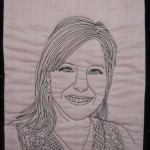
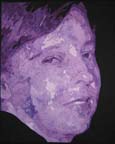
So I set up one of the wonderful lights that I bought for photographing my work and starting taking digital pictures of myself. I turned off the flash & used one of my black design walls as a background. Well, it wasn’t working — so I moved all of the equipment to my closet (no windows) and closed the door. The only light was from my lightstand. I used my husband’s dark suits as the background. And I experimented with moving the light and taking shots of my profile (by the way, one side is better than the other). I finally took one that I knew would work — and then used it as the basis for a simplified drawing. Simple because I knew at that point that I was going to make this many times in different colors.

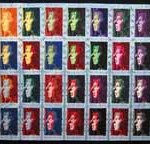
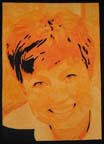
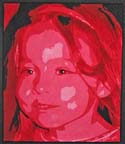
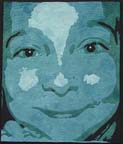
What I have been doing in color portraits has been experimenting with how color affects the face. I have also been reading Deidre Sherer’s book and wondering at how textured fabrics affect the face. The result of this is an experiment in color and texture and the human form multiplied out many times.

profiles in process

Now that I have done all of the basic colors, I’m thinking of inverting them — even mixing them up.

Did I mention that I’m moving next week?

I am desperately trying to make this quilt top knowing that my time in limited and that very soon, I will have no time to work on it. But it has felt wonderful to have my creative soul back.

February 1, 2008

Drawing on Your Quilt Top

A completed top is a lot like a blank piece of paper. Unless it is small and we intend to mount it & frame it, we have to quilt it. To me, adding the quilting is very sculptural. I try to take a picture of the piece just before I quilt it so that it can be compared with the piece after quilting and the full impact of the quilting can be appreciated.

I spend a lot of time creating my quilt tops, and I get so involved in making them, I do not spend time quilting every day. So it is like a rusty wheel that has to be oiled before I get back down to business.

I have a home machine and I quilt my faces on the machine without a frame. (I have a Hinterberg frame but I haven’t gotten a deeper throat machine for it — and I haven’t explored quilting my art quilts on it.) A lot of my lines are sweeping — they go from the top of the face to the bottom. I would love to say that I sit down and just do it — but I can’t. Without the help of a frame, I can’t do this on my home machine.

So, I print out a copy of the original photograph — take out a pencil — and start making lines. It is a rough outline of how I will quilt the piece. If I don’t like the way a line looks, I erase it and draw another line. This is my plan, and it is very forgiving.

Amy with sketched quilting lines

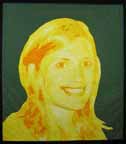
Amy is the wife of a priest and has served as a living angel in the life of my family so I thought that it would be fun to quilt her wings and a halo.

I had someone tell me once that my quilting lines seemed topographical. That is a fairly good comparison as I am trying to mimic the contours of the face.

Now I do something that some would consider scary. I pin the top flat — and I draw on it with water soluble pens. Blue or white, depending on the fabric. Be very careful not to iron over the blue pen — that would make it permanent. I draw on the quilt top directly using my sketch as my guideline. If I draw a line I don’t like, I erase it with water on a Q-tip. It is best to sketch as much as possible before pinning — although I always leave some of it for later. In this case, I left the background to do after I’ve quilted the face. I may change my mind about what I want to do there.

And when I quilt it with needle and thread (I typically use Superior’s MonoPoly invisible thread all over) , I don’t neccessarily follow my lines. Usually, the applique throws off the drawn line some and I can straighten it out with the needle and thread. However, having the guideline of the pen marks on the fabric are very valuable for me to see the entire picture and how it will all work together. The eyes have to work with the nose — the cheeks can’t overwhelm the eyes — the chin needs to work with the cheeks — and in places like the lips and the nose, the quilting lines complete what the applique suggests.

I would be in big trouble if I couldn’t get out the marked lines when I was done because the blue ink on the fabric looks a little scary.

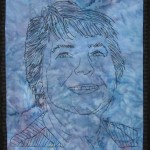
Amy marked with quilting lines

It is very important to be careful with the top until the lines are washed out. Any exposure to heat or soap can set the ink and make it permanent.

As I work, I will spray the sections that I have completed with water to see how the piece is coming along. However, some ink marks will inevitably work themselves back to the surface after it has dried. The only way to know for certain that all of the ink has washed out is to submerge the entire quilt in clean clear water. I will do that once I have finished quilting and binding it.